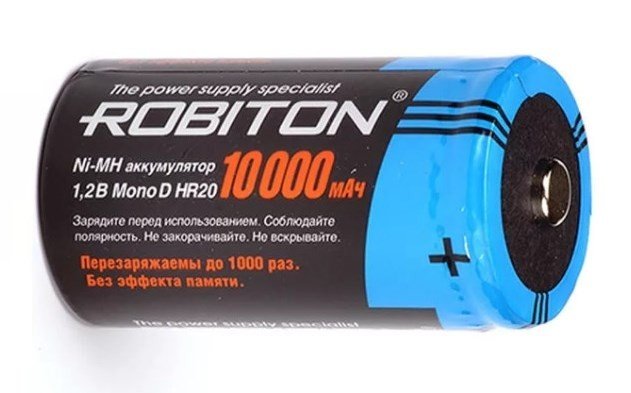
Power supplies have a set of technical characteristics that can be used to select them for operation under given conditions and devices, under various loads. These include shape, dimensions, capacity, voltage, operating time.
The term "battery power"
The term battery power is often used for qualitative assessment., However, it's not entirely technically accurate and refers to voltage, measured in volts (V). This value is indicated on the element's body as a numerical designation. It can be either stated or actual, depending on operating conditions:
- Temperature and humidity of the environment.
- Type of chemical reaction or electrolyte, resistance of the element.
- Integrity of the power supply housing.
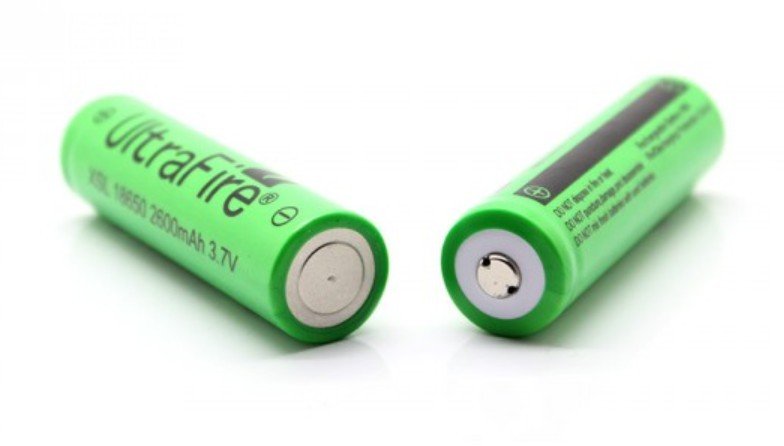
For example, for standard AA battery(primary source) value is 1.5 V. In reality, a new one can produce 1.6 V, and after long-term use - 1.1 V. This is the lower limit up to which it can still be used, after which it is considered inoperative.
Don't confuse them with rechargeable batteries, which are secondary sources that can be recharged. The standard voltage for these is 1.2 V.
For different types of power elements, the nominal (specified) voltage is:
| View | Voltage (V) |
| Saline (R) | 1.5 |
| Alkaline (LR) | 1.5 |
| Lithium (CR) | 3 |
| Silver batteries (SR) | 1.55 |
| Air-zinc (PR) | 1.2 |
| Salt (3R12) | 4.5 |
| Alkaline (3LR12) | 4.5 |
| Saline (6F22) | 9 |
| Alkaline (6LR61) | 9 |
| Lithium (6KR61) | 9 V |
Knowing the battery's power, you can select the loads for its operation, i.e. the technical devices in which it will be used for a long time.
How to measure or determine the power capacity of a battery?
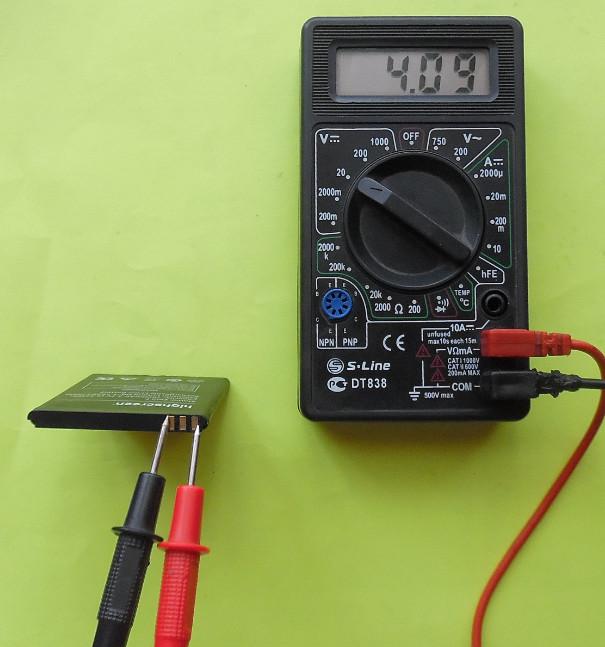
There are often situations when you need to know, How to determine battery power. This is necessary when replacing batteries with those you have on hand or whose suitability is in doubt. To do this, take a multimeter and connect it with a load using the probes to the battery terminals. Wait a short time to obtain the result. If the measured value matches the marking (as stated) or is slightly lower, the battery is safe to use. A voltage reading of 1.1 V indicates that the battery is faulty and is not suitable for further use.
Power can be determined experimentally, without instruments or numerical readings. Hold a battery vertically, lift it about 10 cm from the tabletop, and then release it. A discharged battery will bounce back, making a loud sound on impact, and fall onto the table, shifting its position to horizontal. A charged battery will make a dull sound on impact but will not shift its position, remaining vertical. Chemically, this is explained by the fact that the gel-like electrolyte in an old battery hardens over time, causing it to bounce when dropped from the table.
Conclusions and recommendations
When choosing a power supply for small household appliances, it is necessary:
- Know the required voltage in advance - this value is indicated in the instructions or on the device body along with other characteristics.
- Check the expiration date—otherwise, you risk purchasing a low-quality product, in our case, a dead battery.
- Keep in mind that more expensive components from well-known brands guarantee high-quality, trouble-free operation, unlike cheaper ones.