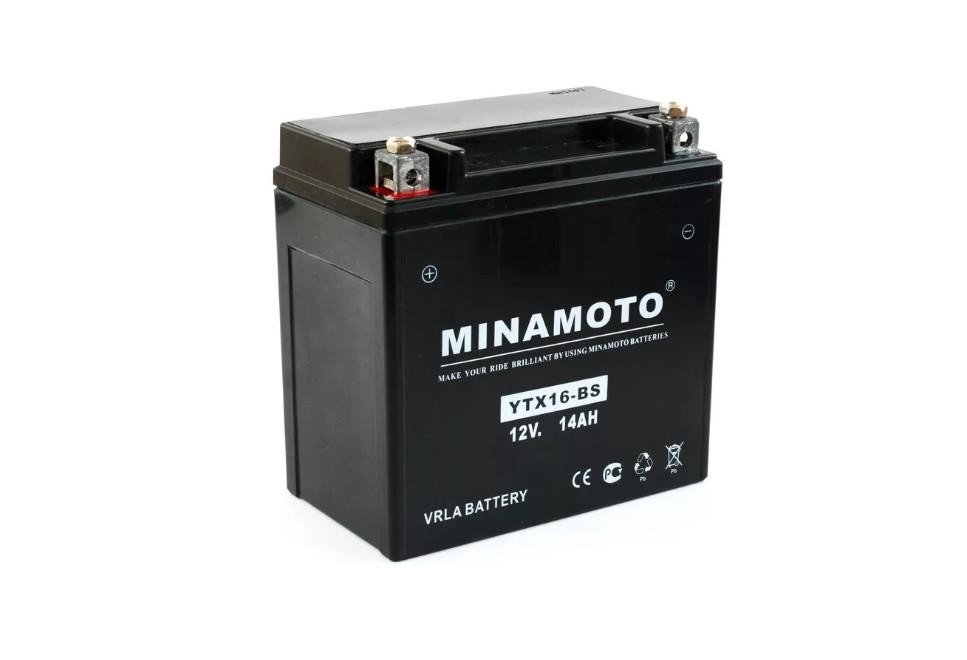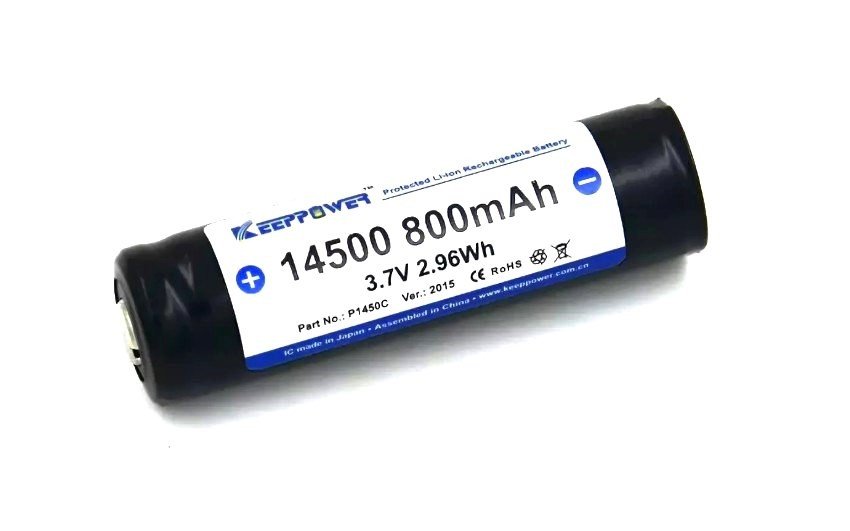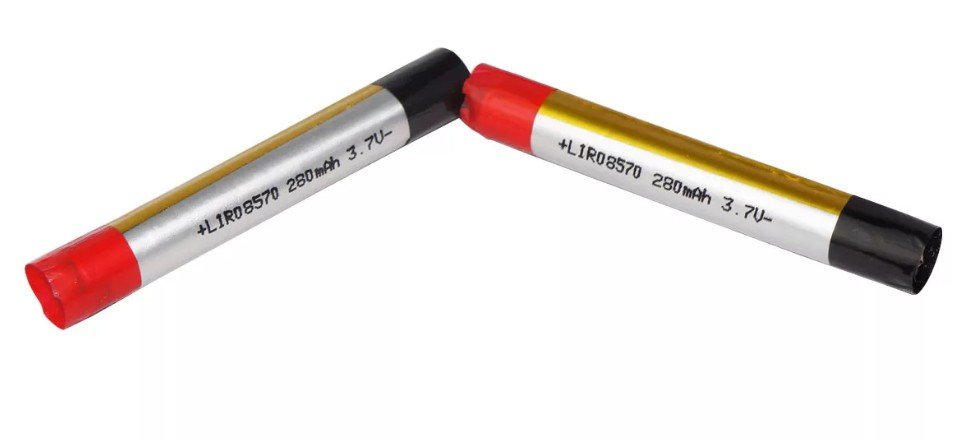
A gel battery is a maintenance-free, sealed power source. It is used in various electrical devices, most commonly in transport. It is manufactured using GEL technology. They are commonly called helium batteries. This doesn't mean they contain helium; the electrolyte is simply a gel-like substance.
These energy storage devices offer many advantages over lead-acid and AGM batteries. Their sealed design allows them to be used in any orientation. Damage to the casing prevents fluid leakage. They are vibration-resistant and feature a long charge/discharge cycle. Recharging is fast and does not emit gases. Therefore, this type is considered the most reliable.
- Technical characteristics of the gel battery
- What is Gel?
- Approximate parameters of gel batteries
- Marking of gel batteries
- Service life of a gel battery
- The main reasons for rapid wear of a gel battery
- Gel battery design
- Operating principle
- How to test a gel battery at home?
- Testing with a load fork
- Types of gel batteries
- Pros and cons of gel batteries
- Pros
- Cons
- How to maintain a gel battery
- Storage and operating conditions for gel batteries
- Charging a gel battery
- How long does it take to charge a gel battery?
- Charger for gel batteries
- Soyuz VS-2410A
- Omnicharge 12-40
- Schematic diagram of a charger for gel batteries
- Replacing electrolyte in a gel battery
- Where is a gel battery used?
- How to distinguish a gel battery from a lead-acid battery?
- What is the difference between a gel battery and a lead-acid battery?
- Manufacturers
- VARTA ULTRA DYNAMIC
- Battery from Optima Yellow Top
- Gel battery DELTA GX 12-60
- Production of gel batteries
- Video about gel batteries
- How much does a gel battery cost?
- Reviews of gel batteries
- Frost and a gel battery
- How to choose a gel battery?
- Which battery should I choose: gel or lead acid?
Technical characteristics of the gel battery
This section will provide the basic parameters.
What's happened Gel?
This is an electrolyte locked in a gel. Gel technology is based on silicon dioxide. The gel provides excellent contact and prevents short circuits between the plates. It's similar to a sponge absorbing water. The gel-like consistency of the gel holds the contents in place. This prevents the plates from falling off.
This type of battery uses purified lead, which has low resistance, allowing for rapid discharge and charge.
The gel battery is housed in a non-removable case. It should never be disassembled under any circumstances. This could disrupt the microclimate and release the gas that protects the plates from oxidation. This gas also ensures 100% battery life. Even if damaged, the battery will still function, albeit at a 30% reduced rate. Naturally, its lifespan will be reduced.
Approximate parameters of gel batteries
- Capacity from 20 – 200 A/h.
- Current strength.
- Nominal voltage 12 volts.
- The weight depends on the capacity, usually it starts from 5 kg.
- Size. Each model has its own size. The DELTA GEL 12-20 is 158 mm long, 77 mm wide, and 167 mm high.
- Operating temperature.
- Service life: 5 – 12 years.
- The maximum charging current for some models reaches 30 amperes.
The starting current or maximum discharge current is in the range of 550 – 950 A.
Marking of gel batteries
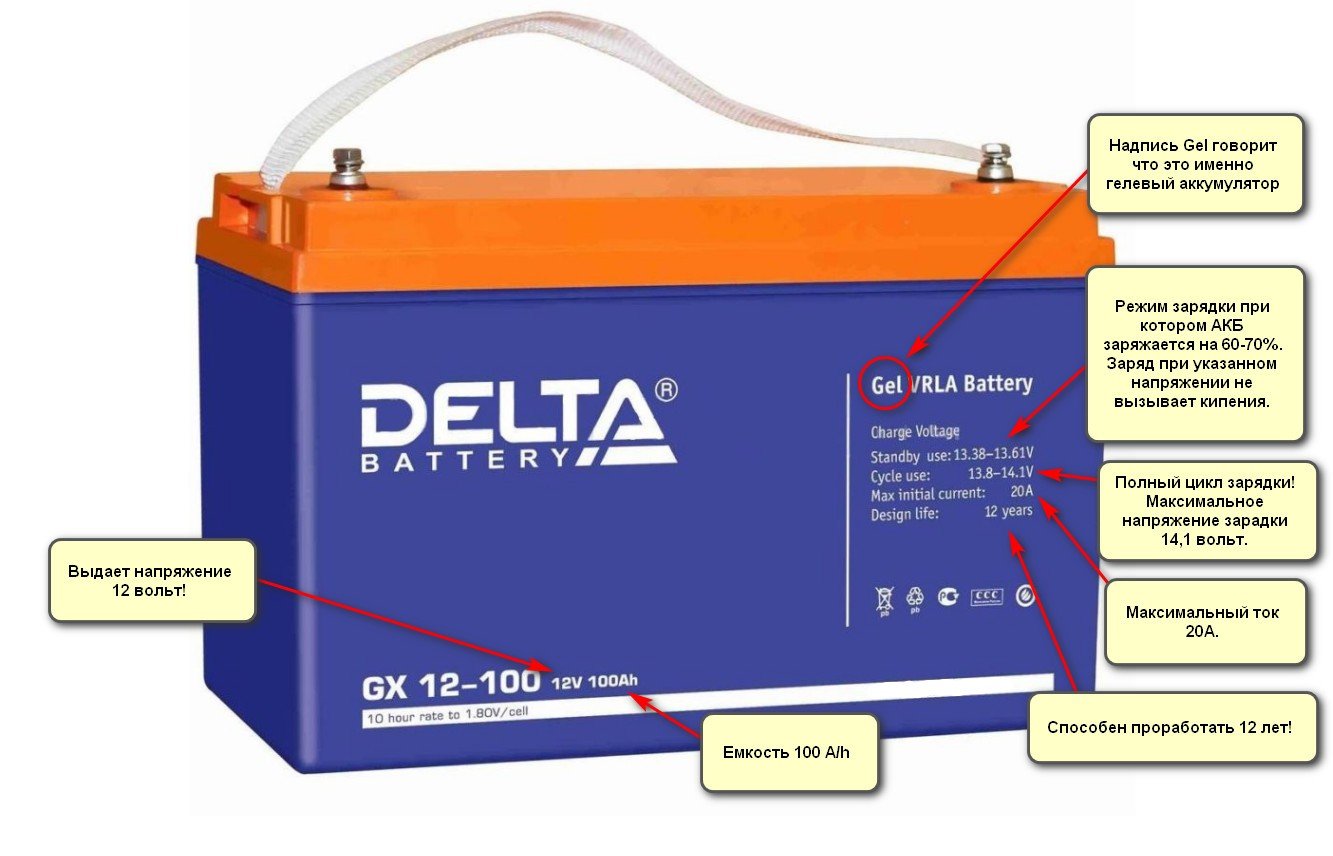
The label contains the most standard markings. These primarily include voltage in volts, capacity in ampere-hours, and type. You can tell it's a gel battery by the "GEL" marking.
There are 4 types of designations:
- Russian.
- Asian.
- European.
- American.
Sometimes you'll see something like 60 A/h. This means the battery can generate 1 A of current for 60 hours.
In addition to this label, you may also find the discharge current or cranking current. For example, a gel battery with a cranking current of 200 amps will not be able to start a diesel engine. However, a 500-ampere battery will be able to power almost any engine, even in freezing temperatures. Assuming, of course, that the battery is in good condition.
In addition to the above, the manufacturer provides information about the production date and service life on the case. The manufacturer's name is also visible.
Below is an example of a battery brand DeltaThe main markings are shown.
Service life of a gel battery
Typically, it's 10 years. Sometimes the manufacturer may claim 15 years. The minimum lifespan is 5 years. However, it can also be determined by the number of charge and discharge cycles.
| Cycles | Percentage of discharge |
| 350 times | 100% |
| About 550 | 50% of the rated capacity |
| Around 1200 | 30% |
Strict adherence to operating conditions will allow the G-Class to operate for more than 7 years.
The main reasons for rapid wear of a gel battery
- Repeated undercharging of the battery.
- Long period of non-disconnection from the charger when the battery is already charged.
- Sharp and frequent temperature fluctuations, especially drops to -30°C and increases to +50°C. High temperatures accelerate the corrosion of the conductive plates.
Gel battery design
This battery uses GEL technology, which prevents the electrolyte from spreading and preserves its charge. EMFone dedicated cell at 2.1 volts.
Below is the structure of 12V gel batteries.
There are two types of similar power elements on sale: those with electrodes in the form of spirals and plates.
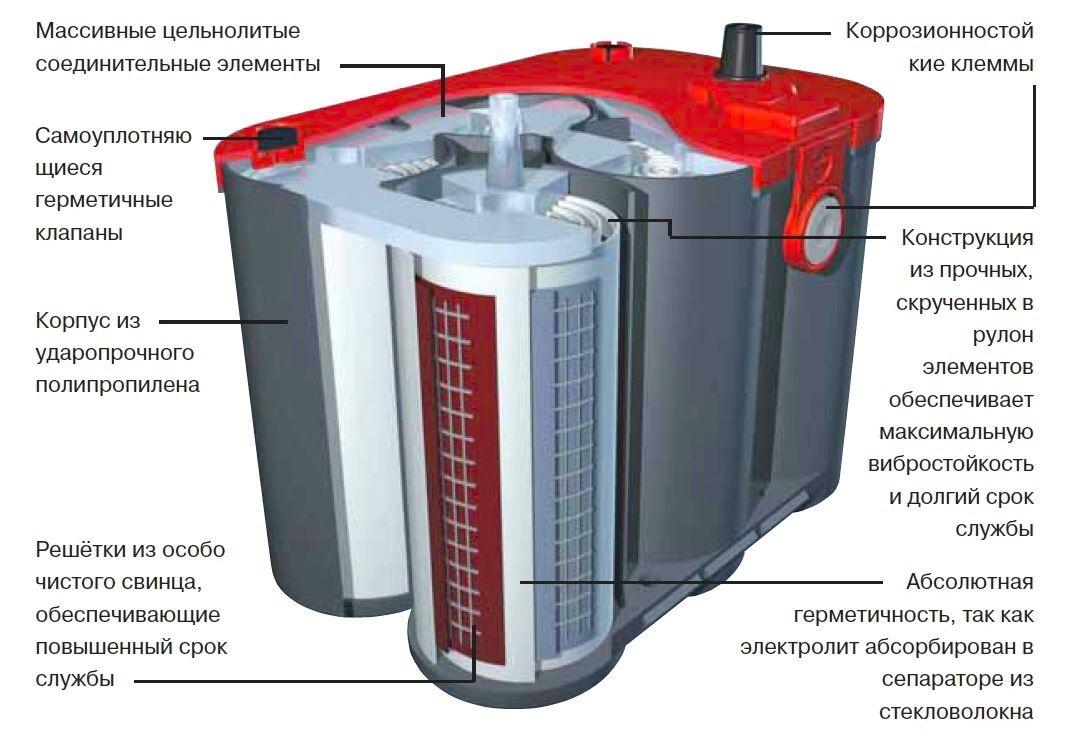
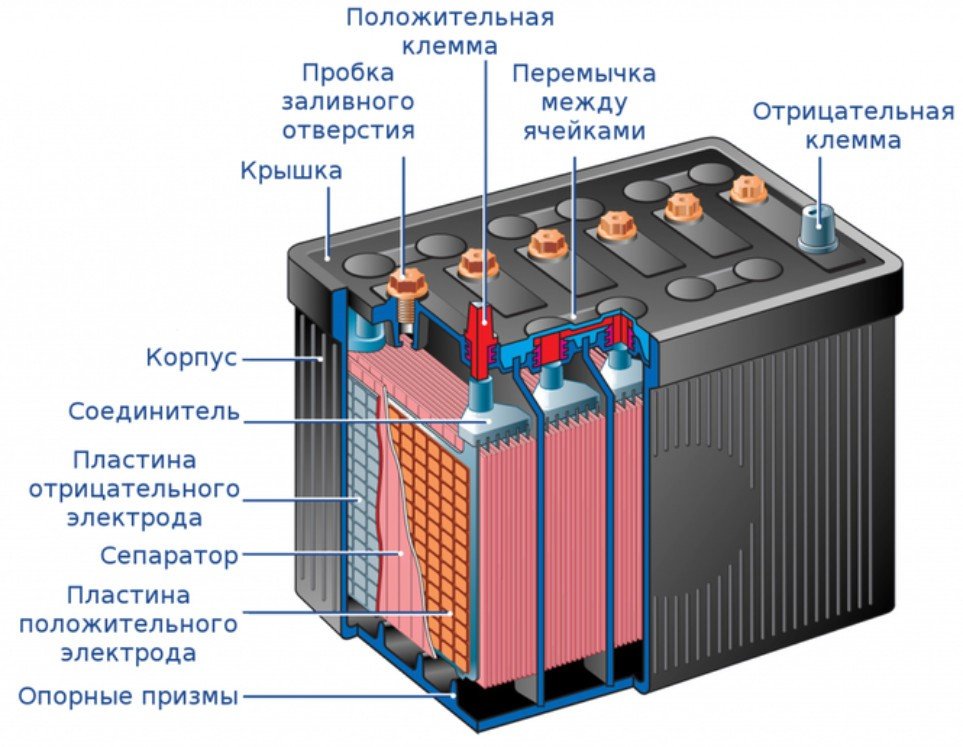
The composition of the gel battery includes:
- Positive and negative marks.
- Frame.
- Separator.
- Support prisms.
- The lid.
- Lead grate.
- Sealed valves.
- A special electrolyte mixed with silicon particles or another substance. This allows it to have a gel-like appearance. Silicon dioxide does not react with sulfuric acid, therefore, it does not impair the battery's overall performance.
- Gas exhaust system.
There are spaces between the electrodes containing separators. They are made of fiberglass. This material has small pores that prevent the paste-like liquid from spreading. This design improves battery performance. The tightly packed electrode plates also increase efficiency. They are made of high-quality lead.
Operating principle
The process of generating electricity is based on the interaction of the electrolyte with the plates. In this battery, the energy fluid is an acid containing a silicone compound. This compound turns the acid into a gel. Distilled water is also included.
When a battery is in operation, some plates ALWAYS oxidize, while others ALWAYS recover!
How to test a gel battery at home?
A standard tester/multimeter will do the trick. Here's the test procedure:
- Remove the battery cover if there is one.
- Disconnect the negative wire from the terminal, and then the positive wire.
- Switch the measuring device to voltage measurement mode.
- Carefully observing polarityConnect the device probes to the battery terminals.
- The voltage level will be displayed on the indicator.
If U is 12.8-12.9 volts, then it’s normal.
12.6 V indicates that the battery is approximately 75% charged. A voltage of 12.3 V indicates that recharging is required, as the battery is only 50% charged.
Testing with a load fork
When the battery is purchased, it is tested with a load plug. This device draws some current. As a result, the voltage should not drop below 9 volts. The test time is 15 seconds according to the Russian GOST standard and 30 seconds according to the European standard. After disconnecting the test plug, the voltage should recover to 12.6-12.7 volts.
If after testing the readings are not equal to the required voltage and the voltage is less than 9 volts, we do not recommend purchasing this battery. It's likely that it has been sitting unused in a storage room for a long time, and its capacity has significantly decreased.
In this way, each consumer can check the GA for functionality.
Types of gel batteries
There are essentially no specific options. They can only be classified by manufacturer, voltage, and manufacturing method.
Available in 2 versions:
- Spiral – the plates are arranged in a helical pattern. The separator, along with the electrolyte, is concentrated in the center of the entire spiral structure.
- Plate - the gelatinous filler is located between flat plates, as in a conventional battery.
According to the voltage level, there are:
- 24-volt. They are designed for trucks and special vehicles.
- 12V. These batteries are ideal for motorcycles, cars, boats, snowmobiles, ATVs, etc.
- 6-volt battery. Required for scooters, buggies, mopeds, and other small vehicles.
Capacity The capacity of such power sources reaches 200 A/h.
The manufacturers will be discussed towards the end of the article.
Pros and cons of gel batteries
What's so great about this energy source? Below, we'll discuss the main advantages and disadvantages of gel batteries.
Pros
- In any position the density will be the same.
- Environmentally safe.
- The gel does not allow gas to reach the surface of the battery.
- Has a long service life.
- Withstands deep discharge. The gel helps prevent the formation of lead oxide sulfate crystals, which can block current flow. However, avoid allowing a 12-volt gel battery to discharge significantly, as this will reduce its service life.
- Small size. This is achieved by the spiral arrangement.
- Holds charge for a long time.
- Easy to maintain.
- Less sensitive to additional powerful vehicle equipment.
- Can reach up to 1000 charge-discharge cycles.
- They are capable of self-recovery after depleting their reserve! This is especially true after prolonged attempts to start the engine. That's why they are sometimes called traction gel batteries or starter batteries.
- The risk of plates falling off is almost non-existent.
- There is no need to add distilled water.
- Service life is more than 7 years.
- The dependence of the electrolyte density on the state of charge is expressed rather weakly than in other batteries.
- You can go a long time without charging.
- Low internal resistance of 3-4 mOhm. This determines the current output rate.
- Weakly susceptible to sulfation.
- Fast charging thanks to the use of fast lead in the design.
- You can use a gel battery indoors. It doesn't emit gas.
The gel coats the lead plates, preventing them from shedding. This reduces the discharge itself and the risk of internal short circuits.
Gases generated inside do not escape. They form bubbles. This allows the case to be completely sealed. Over time, gas would accumulate and expand the case. Therefore, manufacturers have taken care of this and equipped the cases with special valves. By opening these, excess pressure can be released without spilling the liquid.
Due to the completely sealed housing, these batteries are also called maintenance-free. lead-acid batteries.
Cons
- Doesn't tolerate overcharging well. This can reduce battery life. The on-board voltage must be stabilized. A gel battery with a nominal voltage of 12.6 volts cannot be charged at 14.5 volts.
- High price. Typically, it ranges from 600 to 77,000 rubles. It all depends on the company, capacity, and voltage. It's unlikely you'll find a cheap gel battery these days.
- Poor resistance to low temperatures. In severe frost, they lose charge more quickly than conventional lead-acid batteries. They become more brittle.
- You will have to check the charge level frequently.
- Sudden voltage surges reduce service life.
- Charging current limitation. The optimal current for gel batteries is 10% of the capacity in A/h.
- Using a battery at very high temperatures will cause the electrolyte to liquefy. This process is irreversible.
- Fear of short circuits. This can even cause them to fail.
- The regulator relay can kill it if the voltage output exceeds 14 volts. The gel will simply melt.
- Sometimes it's necessary to purchase additional protective terminals with a regulating relay. This will prevent the battery from overvolting.
How to maintain a gel battery
Some consumers leave negative reviews about these types of batteries. These are usually related to the gel melting and the device's performance deteriorating. However, most consumers ignore the operating conditions listed below. If these are not followed, the gel battery will have a short lifespan.
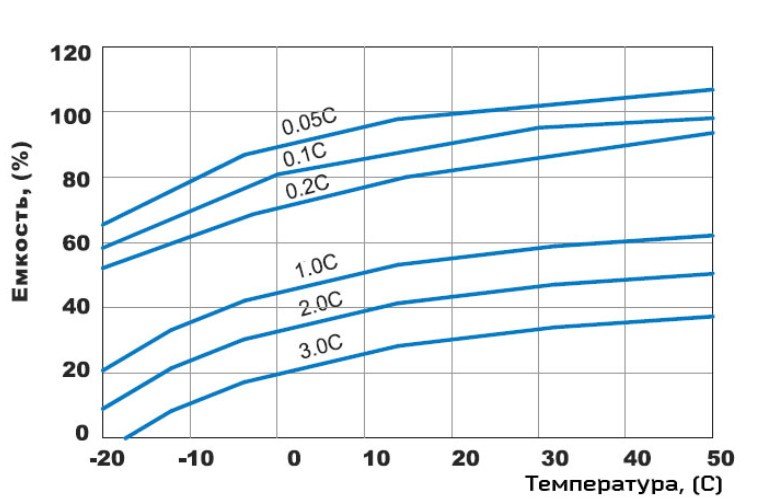
The gas generated inside the battery doesn't escape. Therefore, there's no need to over-check the holes to ensure they're clean. In poor temperature conditions, such as freezing temperatures, the battery's capacity drops by 19%. That's not a huge amount.
It doesn't require any special care. Just don't overcharge or overheat it. Wipe the surface clean of dust and moisture. Be careful not to cause a short circuit. This battery is particularly easy to maintain. It will still start a car even after three years of sitting on a shelf.
Storage and operating conditions for gel batteries
These devices are not particularly demanding, but some rules should be followed.
- Avoid overcharging. The voltage should not exceed 14.4 volts. Otherwise, the electrolyte will begin to boil off, which will damage the battery.
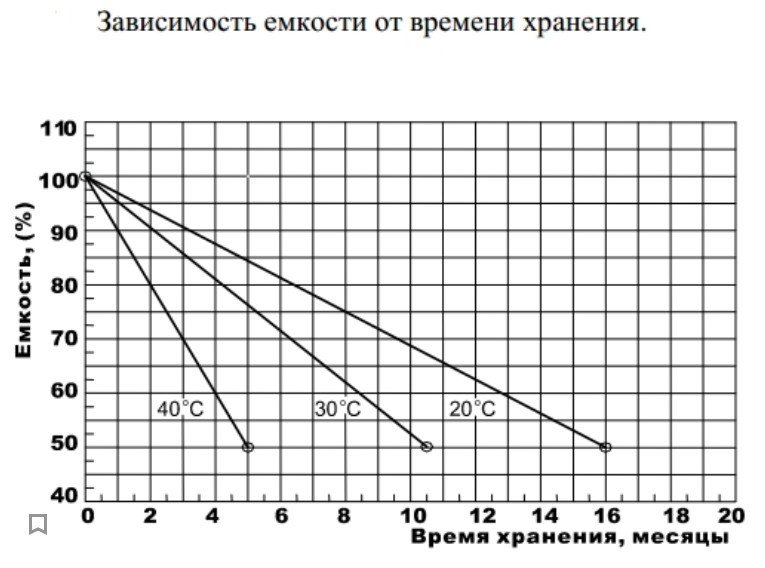
- It should be stored at temperatures ranging from -35 to +50 degrees Celsius. This period should not exceed 6 months.
- Although the manufacturer states that deep discharge is not harmful, it is better not to let it get to that point.
Charging a gel battery
Normal charger It's not suitable for these types of batteries. You need to use one that allows you to adjust the current and voltage. Otherwise, you could damage the power source.
Algorithm for charging a gel battery
- Unscrew the plugs.
- Set the desired voltage and zero current on the charger.
- Connect the charger terminals to the power source observing polarity.
- Set the charger current parameters.
- Monitor the readings periodically. Don't leave the battery alone! 😊 If you notice voltage surges, disconnect it. charger from a current source.
How long does it take to charge a gel battery?
Many experts recommend recharging the battery throughout the day. During this time, the current should be gradually reduced, while the voltage should be monitored. This approach will significantly extend the battery's lifespan and allow it to recharge in just 12-15 hours.
During charging, the voltage may rise above normal. To reduce it, reduce the current.
Using gel makes charging better and faster.
Charger for gel batteries
There are many chargers on the market today. However, batteries made with GEL technology require a special charger.
Soyuz VS-2410A
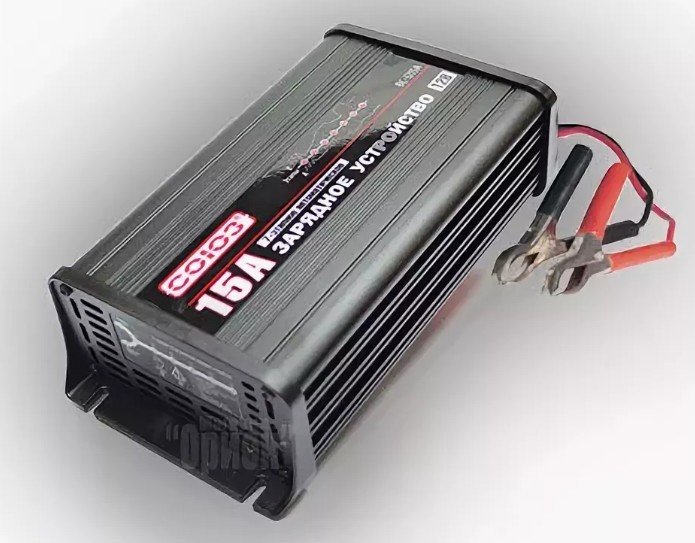
Omnicharge 12-40
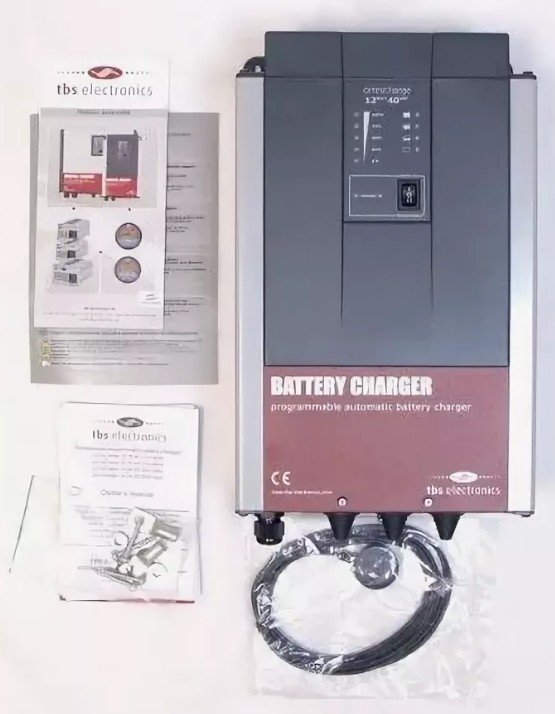
This is a fairly powerful and expensive device.
This way, anyone can revive a gel battery using a charger!
Before purchasing a charger, make sure that it:
- Automatically turn off the power supply after the charging process stops.
- Has protection against overheating.
- Provides stable voltage.
- It features temperature compensation, meaning it adjusts charging parameters based on environmental conditions.
- Can regulate the current strength.
The recommended charging voltage is usually listed on the battery case after the phrase "Cycle use." Gel batteries are designed for trickle charging. The voltage required for this is indicated next to the "Standby use" line.
Schematic diagram of a charger for gel batteries
A homemade charger can be assembled using the diagram below. It is suitable for 12-volt, 7-amp-hour batteries.
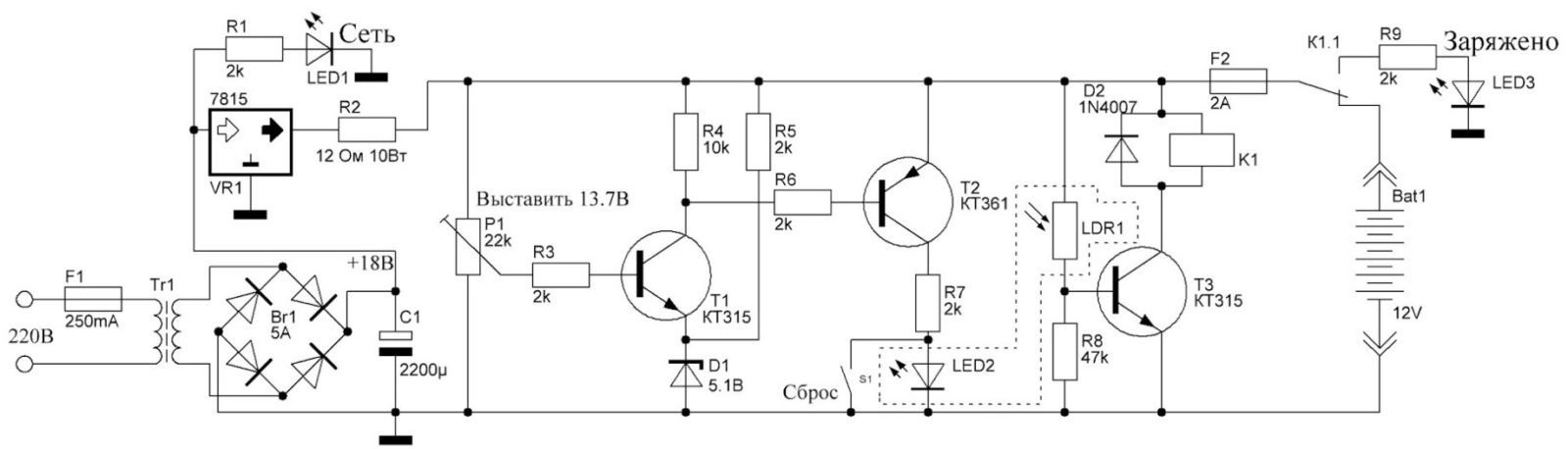
You don't need any rare parts for assembly. They can be purchased at a radio store or found in old, unbroken electronics.
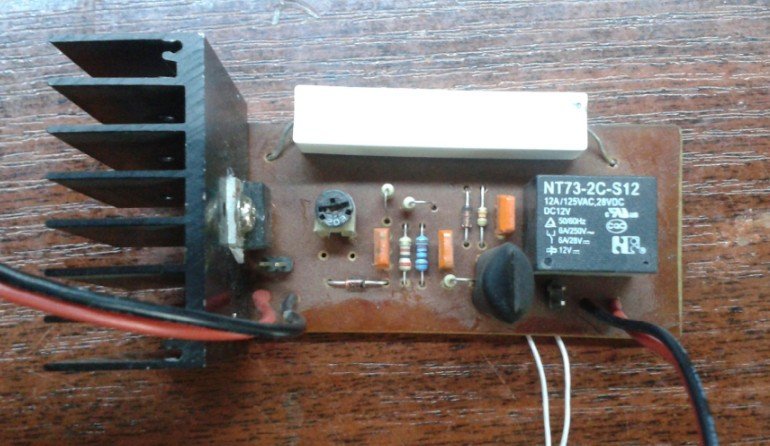
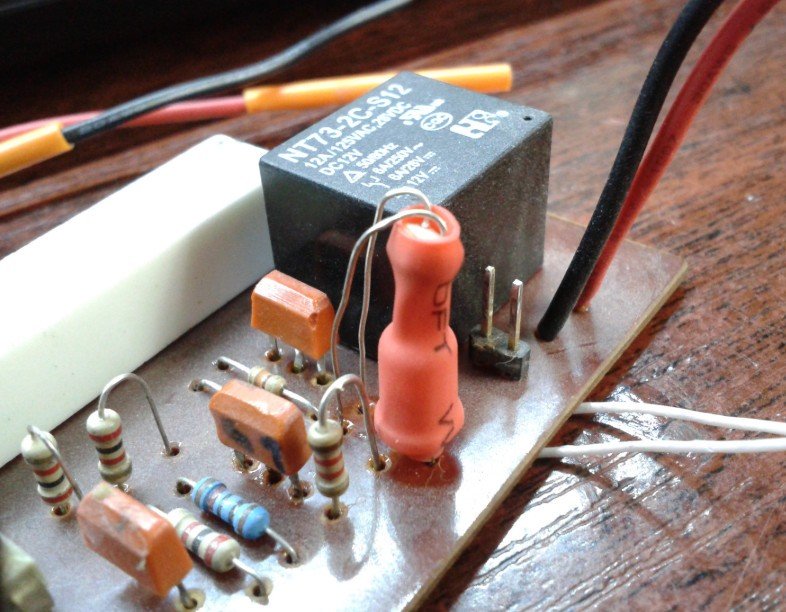

More detailed information about the assembly of the charger is written in these articles:
- https://www.drive2.ru/b/3121981/
- http://radioskot.ru/publ/zu/zarjadnoe_dlja_gelevykh_akkumuljatorov/8-1-0-822
- http://rustaste.ru/improvised-charger-for-gel-batteries-l200c.html
The charging voltage must not exceed 14.4 volts! They are very sensitive to increased charging current! Failure to do so may cause an explosion!!!
Replacing electrolyte in a gel battery
Sometimes a gel battery may lose some of its capacity. This can happen if the contents dry out. To refill, follow these steps:
- Remove the cap.
- Remove the rubber plugs from the body.
- Draw 2 cubes of distilled water into the syringe.
- Pour it into each jar.
- Wait about 4 hours for a reaction to occur.
- If necessary, add more distilled water and let it sit for a while. If there is too much water, drain it.
- Measure the voltage at the terminals.
- Replace the plugs in their original place and close the lid.
- Put the power supply on charge.
For gel batteries, checking the electrolyte density is not necessary. The cast casing ensures no loss of efficiency. Everything is preserved and functions even if damaged.
Where is a gel battery used?
Gel batteries of 6 and 12 volts can be used in:
- Screwdrivers.
- Uninterruptible power supplies (UPS).
- Cars.
- Scooters.
- Motorcycles.
- Snowmobiles.
- Quad bikes.
- Boilers.
- Boat electric motors.
- For solar panels.
- Used for electric wheelchairs.
- Echo sounder.
- Satellites.
- Spaceships.
- Military equipment.
- Street lighting.
- As storage devices for alternative energy from wind turbines.
- Communication equipment.
- Jet skis.
The higher the discharge current or starting current, the more powerful the battery.
How to distinguish a gel battery from a lead-acid battery?
The GEL battery was originally developed for military purposes. Even if damaged, this type can continue to operate for a long time.
You can tell whether a battery is a gel battery by looking at the label on the device itself. It will say "GEL" on the casing.
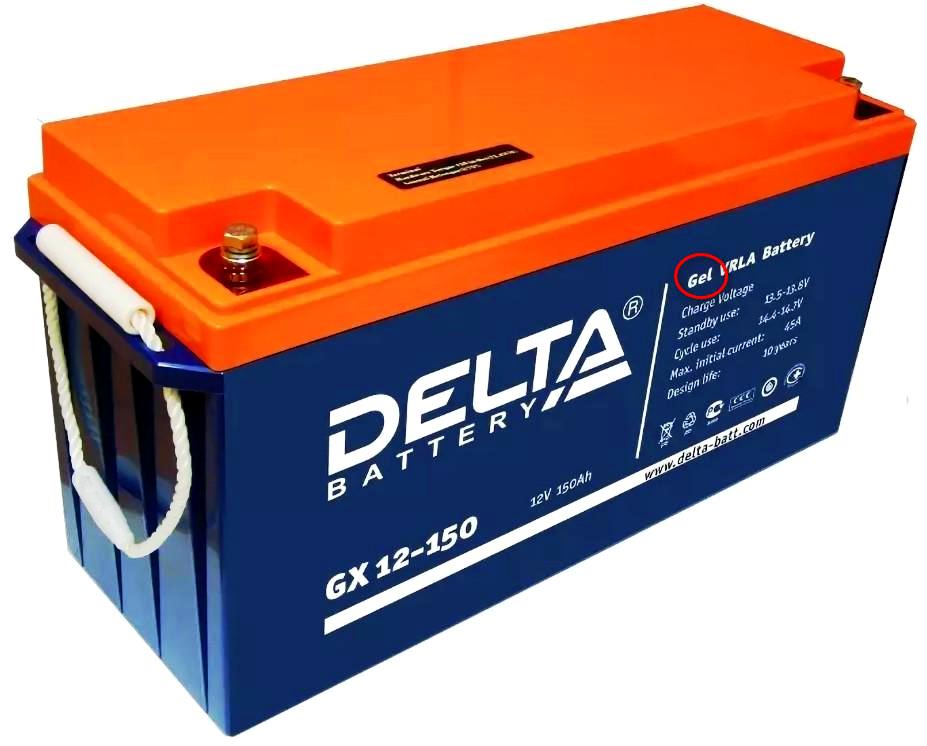
What is the difference between a gel battery and a lead-acid battery?
The main difference from a conventional power storage battery is the presence of a dense electrolyte. This allows the energy source to be used even upside down. It will still work, unlike a lead-acid battery. In a lead-acid battery, both the density and the voltage will change immediately. In a gel battery, everything will remain unchanged.
It is best to use gel batteries for cars with precise electronic components.
Manufacturers
Company VARTA ULTRA DYNAMIC
Gel batteries from Varta companyThis is an invention by German engineers. They succeeded in making the battery reliable. The electrolyte in their model is able to be absorbed into a separate separator and immediately turns into a gel. This battery can operate in any position. However, one drawback is the loss of power at low temperatures. Plus, it's expensive.
battery from firms Optima Yellow Top
This is a development by American scientists. They learned to stack the plates in a special way. This allowed the batteries to be smaller in size. They can be recognized by their cylindrical cells. These low-capacity batteries have a starting current of up to 765 A and can withstand heavy loads. The price of these batteries ranges around 20,000 rubles.
Gel battery DELTA GX 12-60
The manufacturer promises a long service life of up to 10 years. It can withstand temperatures ranging from -40 to +40 degrees Celsius.
Production of gel batteries
To create a thick filler, silicon particles or a fiberglass-based filler are added to the composition. How these batteries are created is actually classified information—a trade secret, so to speak. The video below discusses them a little.
Video about gel batteries
How much does a gel battery cost?
Prices vary depending on specifications. In today's markets, small batteries can be found for as little as 600 rubles. The maximum price can reach up to 80,000 rubles. For that price, you could buy a fully functional motorcycle.
Reviews of gel batteries
There are both positive and negative reviews online about this technological marvel. Some of them are related to complaints about the gel cap. But who knows, maybe these owners grossly violated the operating instructions. For example, they charged it with a high current or exposed it to extreme cold. That's why they didn't like it.
A couple of screenshots with reviews



Frost and a gel battery
Manufacturers claim it can withstand temperatures down to -50 degrees Celsius. But there are some caveats. And overall, this claim is debatable.
Under moderate load in cold conditions, a gel car battery demonstrates advantages over all other battery types. It can also be safely stored in freezing temperatures.
In sub-zero temperatures, the starting current of a Gel battery drops significantly. This can lead to the car not starting in extreme cold.
During cold weather, the gel may freeze. However, some types contain special anti-freeze powders. However, in this case, the cost of the energy source will be significantly higher.
How to choose a gel battery?
Before purchasing, you should pay attention to the following things:
- Maximum load current.
- Nominal voltage.
- Nominal capacity.
- In what mode can it be charged?
- Charge/discharge cycle duration.
- At what temperature can it be used?
- What is it intended for?
- Know the dimensions of the battery to ensure that it fits into the special connector in the car.
- Make sure the terminals are arranged in a convenient order. Otherwise, you'll have to extend the wires going to the battery.
You also need to know the voltage your generator produces. It shouldn't exceed 14.4 volts.
Which battery should I choose: gel or lead acid?
Here you need to consider where you plan to use it. If it's used in aviation or motorcycles, a gel battery is an excellent choice. For an older car like a VAZ, a lead-acid battery is better. The alternator can supply voltage as low as 16 volts, which is very unsuitable for gel technology.
Gel is a more sensitive energy source and can fail in cold weather.
It all depends on where you plan to use it and under what conditions. So make your choice wisely!