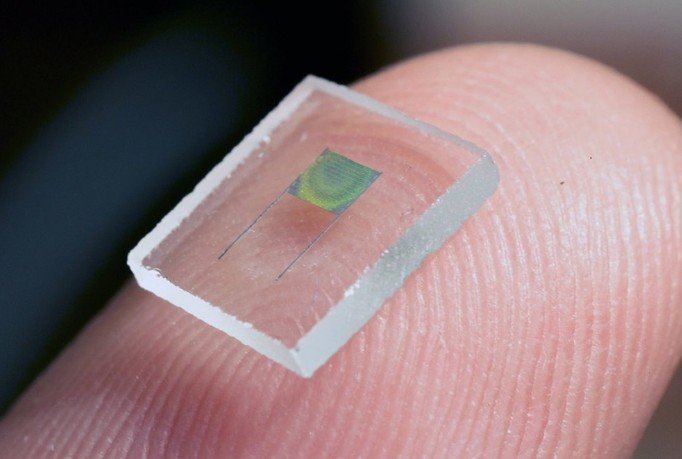
American scientists from the University of Illinois have created the smallest battery. It's a rectangular plate, each side of which measures 2 mm. Its energy capacity is sufficient to power a miniature microchip.
It was possible to produce a small battery using technologies such as:
- 2D photolithography.
- 3D holographic lithography.
Using these two technologies, the researchers were able to increase the surface area of the electrodes and optimize their placement.
To test the smallest battery, a primitive electrical circuit was constructed. It consisted of a red LED and a battery. The bulb lasted a full 10 seconds after 200 recharge cycles. capacitybegan to make up 88% from the initial one. This is a very good result.
Where can such a battery be used?
A similar invention can be applied in radio equipment. For example:
- Implants.
- Drive mechanisms.
- Wireless sensors.
Other scientists from the United States We've worked hard to produce an even smaller miniature power cell. The tin oxide anode measures 100 nanometers long and 10 nanometers wide. The lithium cathode is just under 3 mm long and is housed in a liquid electrolyte with ionization.
The main advantages of this battery:
- Compactness.
- Ease.
- Good efficiency with potential for improvement.
In the future, scientists plan to create a battery the size of a nanoparticle.
Besides these two small batteries, there is another development by an American associate professor named Jae Kwon. This is nuclear power element, and it's based on the decay of a radioactive isotope. This energy source is about the size of a small coin. Using this energy source is completely safe.
The conductor in this development is in a liquid state. As a result, the internal lattice is not damaged by radiation.
In the near future, the researchers will upgrade this power source, increasing its output and reducing its size. They also plan to test it with other materials.
Soon, such batteries can be used in phones, laptops, MP3 players and other portable devices.
Even the smallest battery can last for several hundred years!
Operating principle
It's similar to a solar panel. Radioactive gas or tritium emits a stream of electrons, which are captured on a silicon wafer and then transferred to electrodes.
The decay time of a radioactive substance is 12.5 years. This means we could operate without batteries for that entire time!
The scientists had to endure numerous setbacks before they succeeded. Capturing the electron beam was extremely difficult. To achieve this, they had to create a silicon trap shaped like a non-flat 3D curly bracket. This allowed the electrons to fly into pits or special grooves. These grooves are 40 microns deep and up to 1 micron in size. This allows for the collection of spreading electron beams with a large number of grooves.
Thus, the smallest battery has been created by various researchers! And in the near future, it will become available to the average user!