
When people lose their hearing, they lose contact with the outside world. As a result, careful consideration should be given to the device that restores hearing. Hearing aid batteries should be chosen carefully.
There's a rumor going around that the most important thing is to buy a hearing aid, and any power source will do. But that's not entirely true. If you buy bad batteries, they could ruin your device. Or they might stop working at the most inopportune moment. For example, while crossing a pedestrian crossing.
Types of hearing aid batteries
Hearing aids must be small, discreet, and lightweight. As a result, hearing aid batteries must be miniature and long-lasting. Typically, these batteries last from 5 to 21 days. This short period is due to the constant use of power.
Depending on the operating time, hearing aid batteries are divided into four groups:
- Under the number 675These last the longest. They can be identified by their blue or red color. They last from 7 to 30 days. Capacity610 mAh.
- No. 10. They have a 100 mAh capacity and last for 3-8 days. They are marked yellow. They are ideal for 10C in-ear devices. They are high quality and compact.
- No.13Hearing aid batteries with this number last 6-12 days. They are marked with orange labels and have a capacity of 310 mAh.
- No.312They last from 3 to 12 days. They have a capacity of 180 mAh. They are used for in-ear devices and are marked brown.
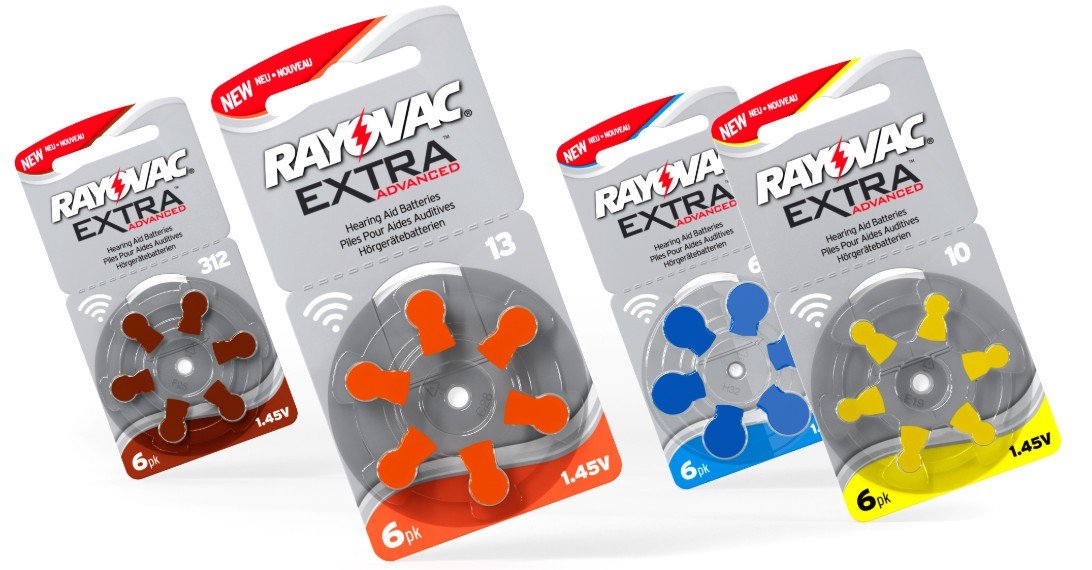
For convenience, some data is included in the table.
| Packaging color | Nominal voltage, V | Capacity in mAh | Standard code | Approximate service life in days | Battery type by number |
| Blue | 1.4-1.45 | 600-650 | PR44 | 10:30 | 675 |
| Orange | 1.4-1.45 | 290-310 | PR48 | 5-14 | 13 |
| Brown | 1.4-1.45 | 150-180 | PR41 | 3-8 | 312 |
| Yellow | 1.4-1.45 | 90-100 | PR70 | 4-12 | 10 |
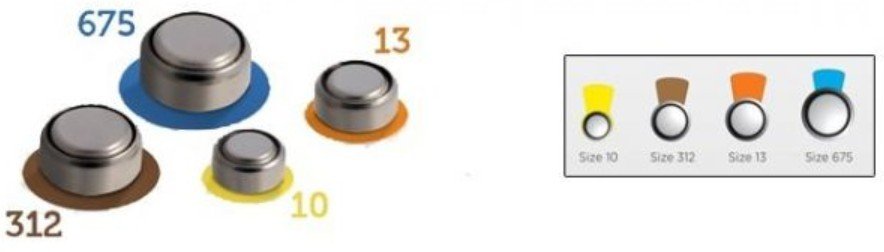
Why do you need to remove the film and when should you do it?
To ensure long-lasting and reliable hearing aid service, a zinc power source is used. These power elements are the best and begin functioning the moment air enters them. Note the plus sign. There is a hole near it, covered with a film.
Before inserting hearing aid batteries, peel off the protective film to allow a chemical reaction to occur. After 3 minutes, you can insert the battery into the device.
The main difference between zinc batteries and conventional ones is that the reaction can no longer be stopped. They can maintain a constant voltage and are unaffected by surges in power consumption.
Battery life for hearing aids
The operating time of these energy sources depends on:
- Additional functions built into the device.
- Size. Small dimensions indicate a short battery life.
- Device operating time. You can turn off your hearing aid while you sleep.
- Ambient humidity. If it's too high, the battery discharges quickly. If it's too low, the battery dries out.
- The level of hearing loss. If the hearing loss is severe, people usually turn up the volume. This accelerates the discharge process.
Power consumption also depends on the type of hearing aid. For example, behind-the-ear hearing aids have longer battery life, up to 21 days. In-the-ear hearing aids can last up to 14 days. In-the-canal hearing aids last up to 7 days.
It's best to buy hearing aid batteries in bulk. This way, you won't have to run to the store in an emergency. Keep them on hand at all times.
After removing the protection, be sure to wait 1-5 minutes and then insert the tablet element into the device.
How to store hearing aid batteries?
Storage requires that the film covering not be removed. Batteries should be stored at room temperature. Never refrigerate batteries, as this may damage them. Keep them away from fire and water. Exposure to high humidity can cause rust. If the device is not in use for an extended period, remove the batteries from the device. Otherwise, they may leak.
To be on the safe side, always keep a spare pack at home. It's best to buy batteries from the same place where you bought your hearing aid. They're usually sold in blister packs of six.
If you follow all storage rules, the battery can be used even after 3 years!
Can hearing aid batteries be recharged?
Recharging is only possible when the battery is connected. Zinc-air batteries are not batteries, so they cannot be charged. If you try to charge a button cell battery, it may explode or leak.
Currently, the industry has begun producing Ni-Mh (Nickel Metal Hydride) batteries. These hearing aid batteries have the same color coding as regular batteries.
| Battery designation | p10accu | p312accu | p13accu | p675accu |
| Battery analogs | 10 | 312 | 13 | 675 |
| Weight, gr. | 0.3 | 0.6 | 0.9 | 2 |
| Color | Yellow | Brown | Orange | Blue |
| Diameter, mm | 5.8 | 7.9 | 7.9 | 11.6 |
| Height, mm | 3.6 | 3.6 | 5.4 | 5.4 |
| Capacity, mAh | 12 | 23 | 31 | 74 |
Hearing aid battery manufacturers
Several reputable companies are developing power sources for such devices. You'll find them listed below.
- Widex.
- Videx.
- Phonak.
- Powerone.
- Siemens.
- Panasonic.
- GP.
- RAYOVAC.
- Camelion.
- EcoPower.
- Sony.
- IcellTech.
- Kodak.
- Energizer.
- Renata.
Many people choose WIDEX hearing aid batteries. But don't focus on just one manufacturer, as others are just as good. The only difference may be the price, which is sometimes unreasonably high.
How to insert a battery into a hearing aid?
- Prepare the energy source by removing the film from it.
- Wait about 5 minutes to allow the reaction with oxygen to occur.
- Open the battery compartment.
- We insert the battery with the positive pole facing the positive. The symbol is written on the cover.
- We close the battery compartment until it clicks into place.
Always insert hearing aid batteries according to the instructions polarity.
Also read: Energy storage devices PR48

My type 13 batteries (PR-48) are self-charging and charge from a 1.5V battery, and they don't swell or explode. And if the batteries in my hearing aids were improved, they would perform better than rechargeable batteries!
There is no point in recharging them, they don't last long, but using a clip to store batteries is very useful: the current stops, is saved without loss, and continues to work.