Development of tritium or uranium batteries has been underway for a long time. In 2011, production of batteries that last for 20 years began in America. They have a voltage of 3 volts and a discharge current of 16 nanoamps. This gradually drops to five.
Where is it used?
Tritium battery is used in:
- Pacemakers.
- Implants.
- Sensors for geologists and oil workers.
- The space industry. Especially in research vehicles.
- Sights with illumination.
- For the operation of military indicators.
- Aircraft.
These devices require low current but long-term operation.
The uranium battery operates at temperatures from -40 to +80 degrees Celsius.
The working principle of a tritium battery and research in this area
It functions through the decay of the hydrogen isotope tritium. This topic was explored back in the 1950s. Research was conducted with nickel, strontium, and yttrium. However, nothing useful was produced from these materials.
Only tritium produced the desired result. It can produce a gentle electron flow. This helped create a long-lasting power source.
Electrons within the energy source move uniformly in both directions. Electricity is generated in silicon wafers. Less than 50% of the electrons were captured through the interaction of electrons with p-n junctions.
To solve this problem, University of Rochester scientists made holes in the surface of silicon wafers. Now, tritium completely fills the holes. Furthermore, it is completely surrounded by silicon.
The resulting tritium battery can withstand temperatures of -50 degrees Celsius and +150 degrees Celsius for extended periods. Tritium decays over a period of 12.262 years. The end result is:
- Electrons
- Antineutrino
- Helium 3
Due to the low energy of electrons, they can easily be trapped using ordinary paper, rubber or fabric.
Manufacturers have taken care of safety
Tritium batteries have a well-made casing that does not allow radiation to penetrate into the external environment.
Industry extracts tritium by irradiating it with lithium isotopes and neutrons. Another technology involves reprocessing heavy water (a nuclear reactor moderator).
Essentially, the isotope is not dangerous to the human body. Its radiation only penetrates a few millimeters into the air. If it enters the body through water, it is dangerous.
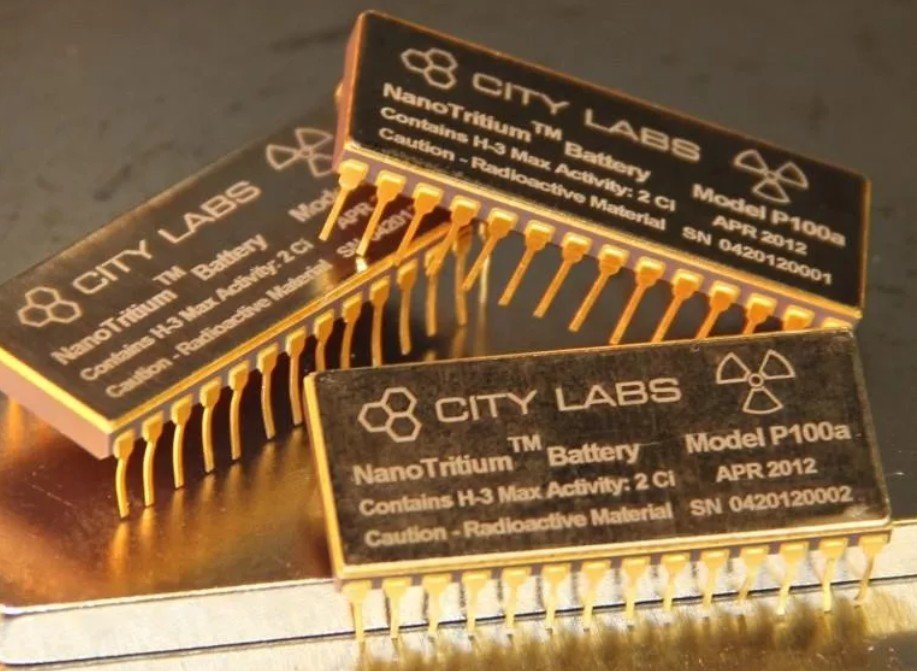
CityLabs was founded in 2005. Its primary focus is producing tritium batteries. Its director, Larry Olsen, created a long-life battery in the 1970s. The same company also developed the NanoTritium battery, developed in 2018 and known as the P100. Its voltage is 0.75 volts, producing 75 nanowatts of power.
The positive terminal is pin 1 of the microcircuit. The negative terminal is pin 15. Externally, this battery resembles a standard microcircuit. It is manufactured in LCC68 and LCC 44 packages.
The tritium battery, unlike its younger, short-lived brothers, has a number of advantages:
- The pressure inside the case does not increase.
- No chemically active substances.
- The body is not destroyed.
- Easily withstands mechanical impacts.
- The substances produced by the operation of a tritium battery are not toxic.
The only drawback of this type of power supply is the price. It currently varies greatly, but is roughly $2,000.
Read also the article atomic battery.