Many schoolchildren have had the chance to make a battery out of a lemon during chemistry, physics, or art classes. It sounds strange, as everyone is used to seeing standard batteries. But a power source made from a fruit is something quite unusual!
How to make a battery from a lemon?
In reality, a similar setup can be built from any fruit. The only difference will be the voltage. Lemon has an advantage: it contains citric acid, which can generate a higher electrical current.
Here's what you'll need to make a lemon battery:
- Lemon – 1-2 pieces.
- One piece of copper wire. For a larger experiment, you can use more. If you don't have enough, you can use a coin.
- Zinc plate. This can be a regular metal bolt, screw, or wire.
- Multimeter or tester to determine voltage.
- An LED. This will allow you to clearly indicate that current is present.
As you can see, the production of this battery is based on just three things.
Step #1.
Take a lemon and mash it a bit. You can also wash and wipe it if you like, although it's not that important.

Step #2.
Place a copper conductor at a shallow depth of up to 2 cm and a metal one not far from it.
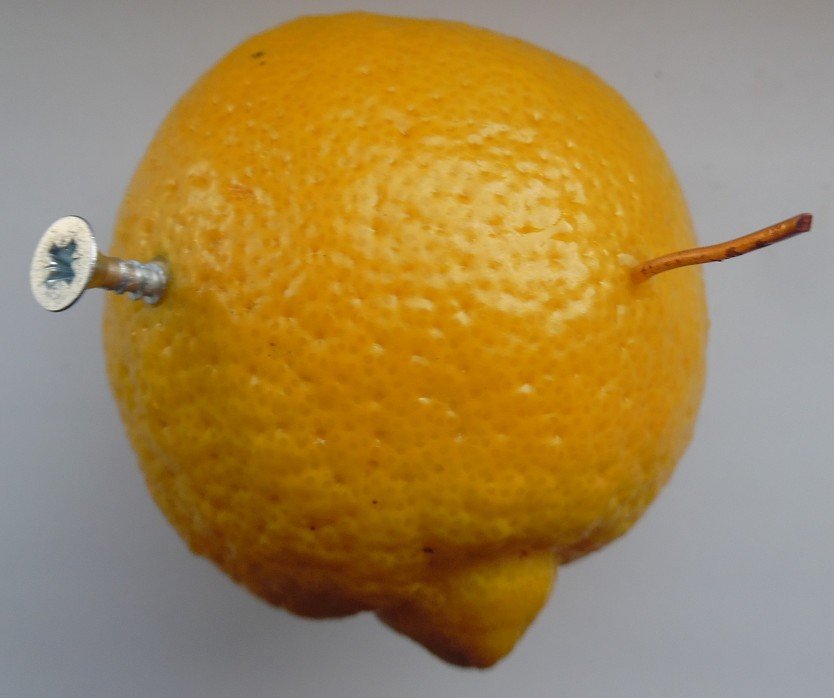
Step #3.
Connect the wires to the protruding rods.
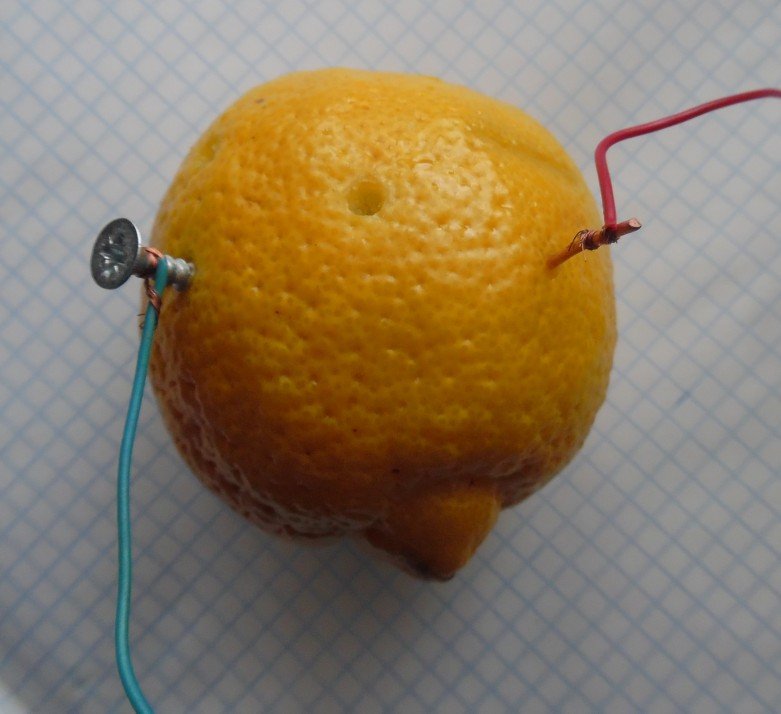
Step #4.
Use a multimeter to test how many volts this unit produces.
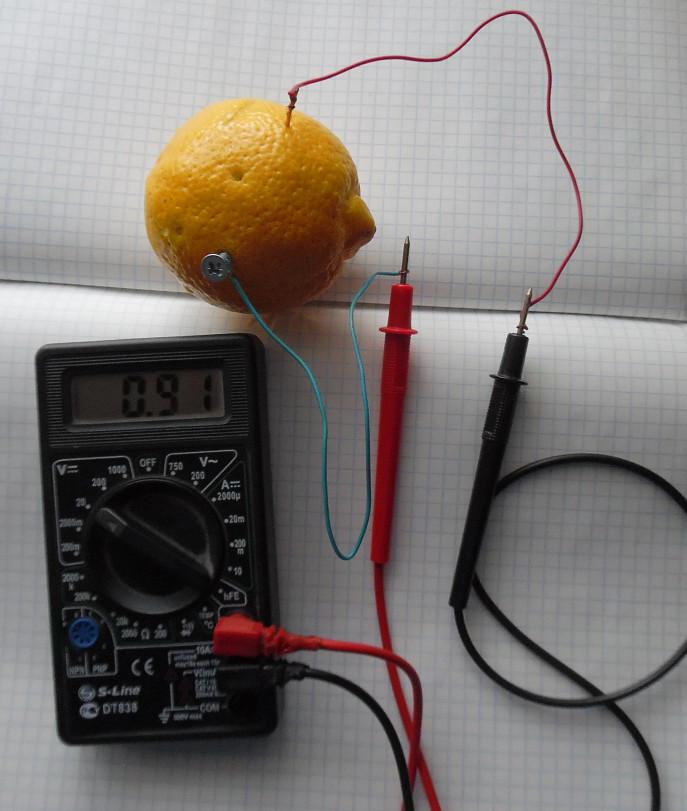
The result is 0.91 volts!
Step #5.
Assemble the second lemon battery and connect them in series. Alternatively, add another copper and metal wire. Then connect them diagonally.
The thing is that the LED will not light up from one battery, so you will need a second one.
Thus, a lemon battery can reliably produce electric current.
Explanation: This type of battery operates based on the interaction of two conductors of dissimilar metals. After they are placed in a lemon, they are surrounded by a citric acid solution. This substance acts as an electrolyte. This initiates a chemical reaction and the ions move, releasing energy.
It is best to use copper wire instead of a coin.