Science is currently progressing and developing. A nuclear battery has already been invented. Such an energy source can last up to 50, and sometimes up to 100 years. It all depends on the size and the radioactive substance used.
Rosatom was the first to announce the production of a nuclear battery. In 2017, the company presented a prototype at an exhibition.
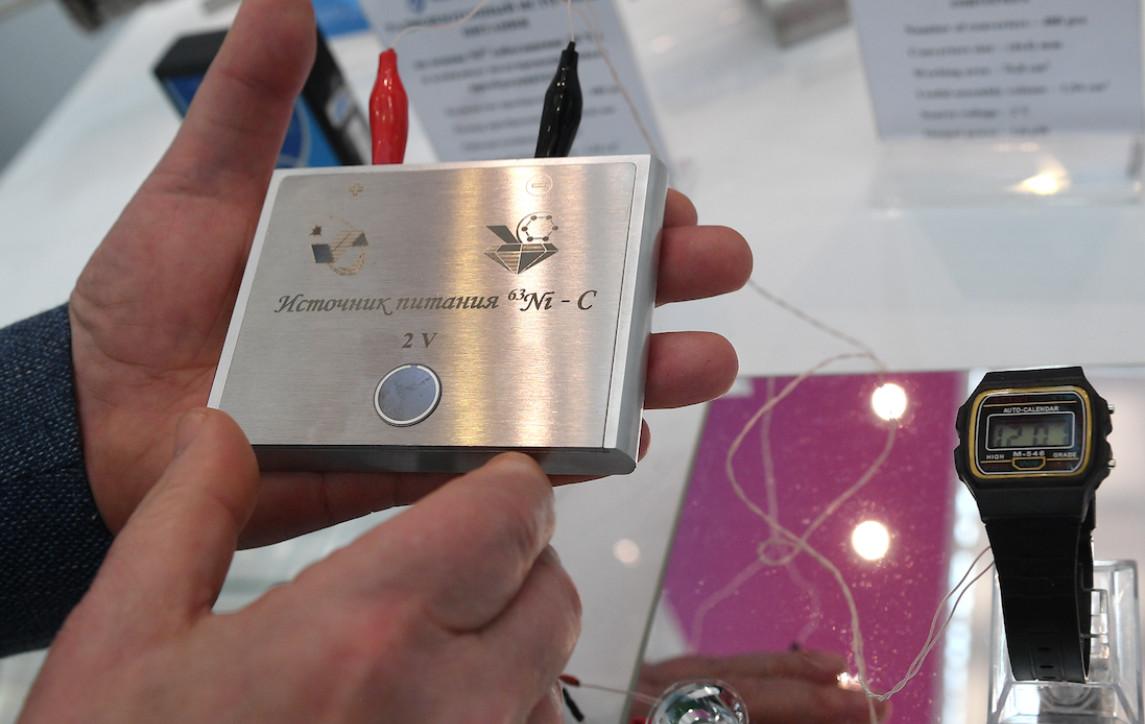
Researchers have succeeded in optimising the layers of a nuclear battery that uses the beta decay of the nickel-63 isotope to generate electricity.
1 gram of this substance contains 3300 milliwatt hours.
- How an atomic battery works
- Are nuclear batteries dangerous?
- Advantages of a nuclear battery
- Disadvantages of a nuclear battery
- Nuclear battery for smartphones
- Where are nuclear batteries used?
- Nickel-63 nuclear battery and its characteristics
- Composition of a nuclear battery
- A carbon-14 nuclear battery that lasts 100 years.
How an atomic battery works
An atomic battery, also known as a radioisotope heat generator (RIHG), is a power source that uses the decay process of radioactive isotopes to generate heat and, in turn, convert it into electrical energy.
The operating principle of an atomic battery is based on radioactive decay, in which the nuclei of atoms disintegrate, emitting particles and energy. One of the most common materials used in atomic batteries is plutonium-238, which has a long half-life. Plutonium-238 decays into uranium-234, emitting alpha particles. These particles contain high energy, which is converted into heat when interacting with the environment.
Heat generation is a key step in the operation of an atomic battery. Heat is transferred through a heat exchanger to a thermoelectric converter. This converter contains materials capable of generating electric current when subject to a temperature difference. Thus, heat from the radioactive decay of plutonium-238 is transferred to one side of the thermoelectric converter, creating a temperature difference between its two sides. This temperature difference enables the generation of electrical energy using the Seebeck thermoelectric effect.
The electrical energy generated by a thermoelectric converter is used to power electrical devices. The main advantage of atomic batteries is that they provide a stable, long-lasting energy source, requiring no replacement or recharging for many years. However, due to the use of radioactive materials, atomic batteries carry certain risks and require special safety precautions during use and handling.
Are nuclear batteries dangerous?
The developers claim that these batteries are completely safe for ordinary people. This is because the housing is well-designed.
Beta radiation is known to be harmful to the body. But in the newly created nuclear battery, it is soft and will be absorbed within the energy cell.
Currently, experts identify several industries in which the Russia A123 nuclear battery is planned to be used:
- Medicine.
- Space industry.
- Industry.
- Transport.
Besides these areas, new long-lasting energy sources can also be used in others.
Advantages of a nuclear battery
A number of positive qualities are highlighted:
- Durability. They can last up to 100,000 years.
- Ability to withstand critical temperatures.
- Their small size allows them to be made portable and used in compact equipment.
Disadvantages of a nuclear battery
- Complexity of production.
- There is a risk of radiation exposure, especially if the housing is damaged.
- Expensive. A single nuclear battery can cost between 500,000 and 4,500,000 rubles.
- Available to a limited circle of people.
- Small selection.
Nuclear battery research and development is being pursued not only by large companies but also by ordinary students. A student in Tomsk, for example, has developed his own nuclear-powered battery that can operate for approximately 12 years without recharging. The invention relies on the decay of tritium. This battery's characteristics remain unchanged over time.
Nuclear battery for smartphones
As of 2019, nuclear power sources for phones are being produced. They look like the one shown in the picture below.
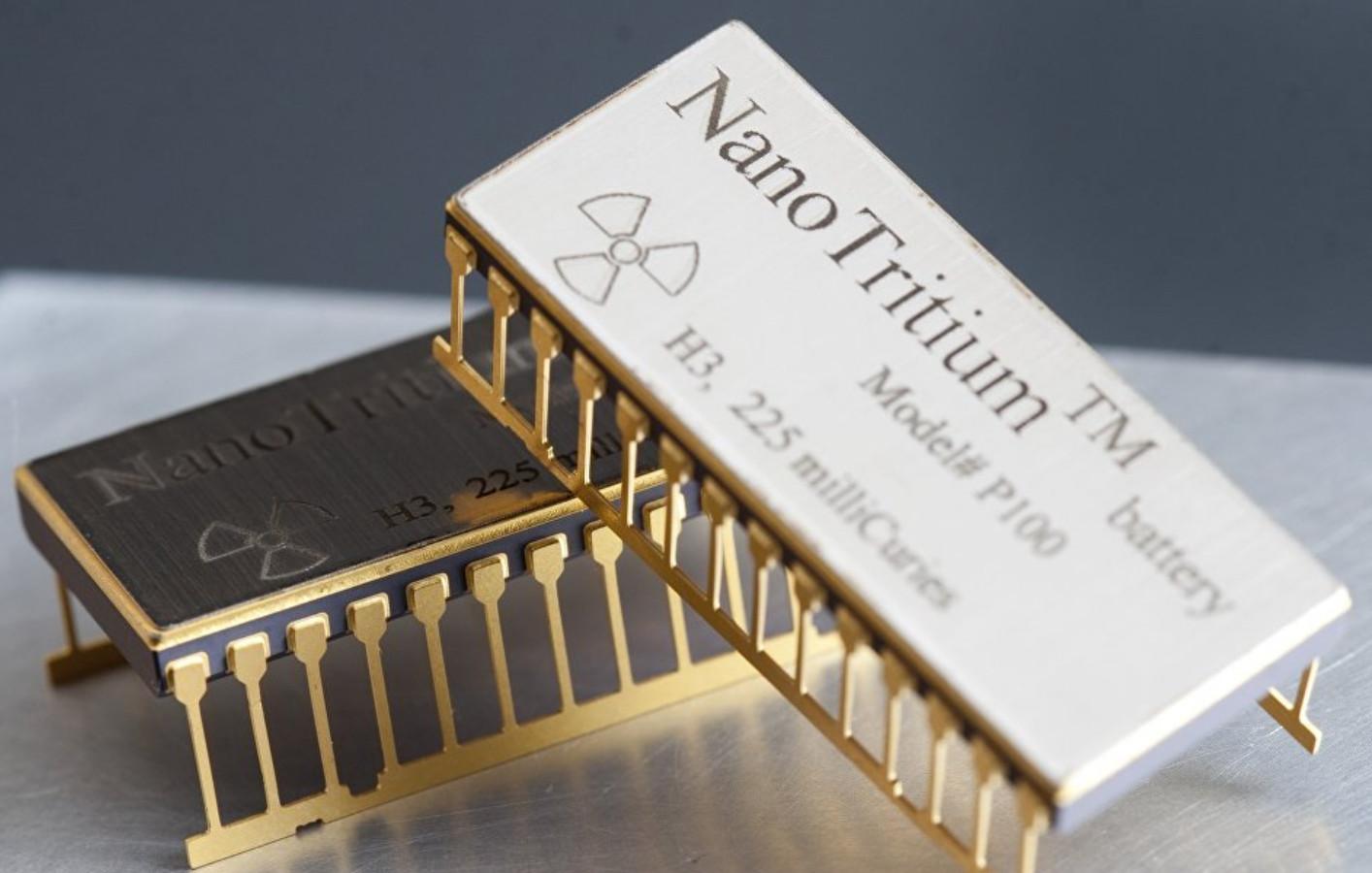
They resemble a microchip that fits into special slots in a cell phone. Such a battery can last for 20 years, and it doesn't need to be charged during that time. This is possible thanks to the process of nuclear fission. However, this energy source may be alarming to many. After all, everyone knows that radiation is harmful and detrimental to the body. And few people would enjoy carrying such a phone around all day long.
But scientists claim this nuclear battery is completely safe. Tritium is used as the active substance. The radiation emitted during its decay is harmless. You can see tritium in action on a glow-in-the-dark quartz watch. The battery can withstand temperatures as low as -50°C and operates reliably at temperatures as high as 150°C.0. At the same time, no fluctuations in its work were noted.
It would be nice to have such a battery on hand, at least to recharge your phone with a regular battery.
The voltage of such a battery fluctuates between 0.8 and 2.4 volts. It also generates between 50 and 300 nanoamps. And all this occurs over a period of 20 years.
The capacity is calculated as follows: C = 0.000001W * 50 years * 365 days * 24 hours / 2V = 219mA
The battery is currently valued at $1,122. Converted to rubles at the current exchange rate (65.42), that would be 73,400 rubles.
Where are nuclear batteries used?
The scope of application is practically the same as that of conventional batteries. They are used in:
- Microelectronics.
- Pressure and temperature sensors.
- Implants.
- As power banks for lithium batteries.
- Identification systems.
- Hours.
- SRAM memory.
- For powering low-power processors, such as FPGA, ASIC.
These are not the only devices; their list will expand significantly in the future.
Nickel-63 nuclear battery and its characteristics
This nuclear power source, based on the 63 isotope, can last up to 50 years. It operates through the beta-voltaic effect. It is almost identical to the photoelectric effect. In this effect, electron-hole pairs in the semiconductor crystal lattice are created by the action of fast electrons or beta particles. In the photoelectric effect, they are created by the action of photons.
A nickel-63 atomic battery is produced by irradiating nickel-62 targets in a reactor. Researcher Gavrilov claims this process takes about a year. The necessary targets are already available in Zheleznogorsk.
If we compare the new Russian nickel-63 nuclear batteries with lithium-ion batteries, they will be 30 times smaller.
Experts claim that these energy sources are safe for humans because they emit weak beta rays. Furthermore, they are not released externally, but remain inside the device.
This power source is currently ideal for medical pacemakers. However, the developers haven't disclosed the cost. However, it can be calculated without them. One gram of Ni-63 currently costs approximately $4,000. Therefore, a fully functional battery would require a significant investment.
Composition of a nuclear battery
Nickel-63 is extracted from diamonds. However, obtaining this isotope required the development of a new technology for cutting the durable diamond material.
A nuclear battery consists of an emitter and a collector separated by a special film. As the radioactive element decays, it emits beta radiation. This results in its positive charge. At the same time, the collector becomes negatively charged. This creates a potential difference, generating an electric current.
Essentially, our atomic power cell is a layered pie. 200 nickel-63 power sources are sandwiched between 200 diamond semiconductors. The power source is approximately 4 mm high and weighs 250 milligrams. Its small size is a major advantage for the Russian atomic battery.
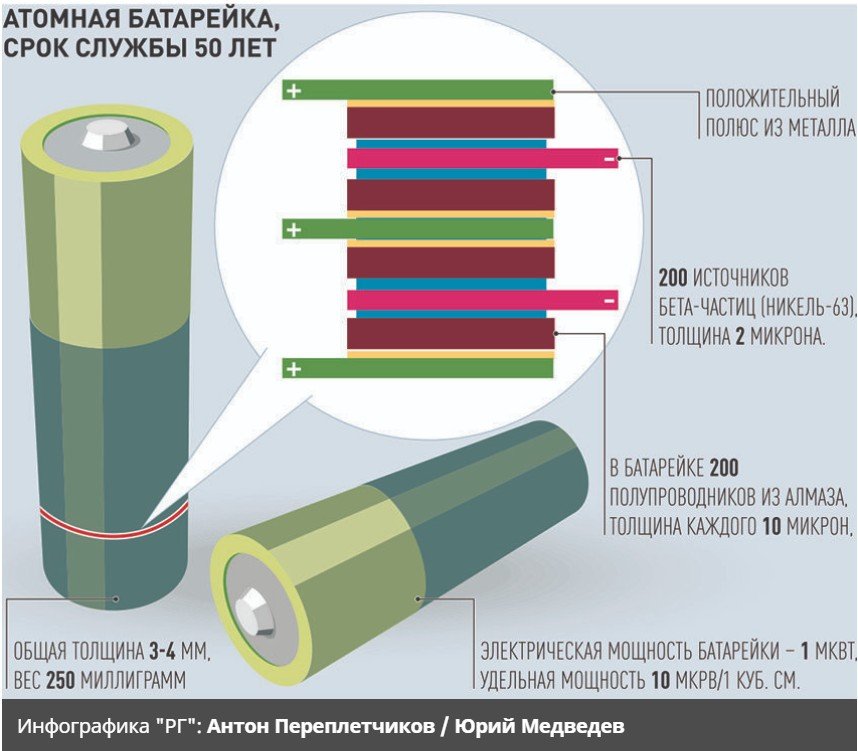
Finding the right dimensions is difficult. A thick isotope will prevent the electrons it produces from escaping. A thin isotope is disadvantageous, as it reduces the number of beta decays per unit of time. The same applies to the thickness of the semiconductor. The battery performs best with an isotope thickness of about 2 microns, while a diamond semiconductor requires 10 microns.
But what scientists have achieved so far isn't the limit. The exhaust emissions could be increased by at least three times. This means a nuclear battery could be made three times cheaper.
A carbon-14 nuclear battery that lasts 100 years.
This atomic battery has the following advantages over other radiation energy sources:
- Cheapness.
- Environmentally friendly.
- Long service life up to 100 years.
- Low toxicity.
- Safety.
- Capable of operating in extreme temperature conditions.
The radioactive isotope carbon-14 has a half-life of 5,700 years. It is completely non-toxic and inexpensive.
Not only the US and Russia, but other countries as well are actively working to modernize nuclear batteries! Researchers have learned to grow film on a carbide substrate. As a result, the substrate's cost has decreased by a factor of 100. This structure is resistant to radiation, making this energy source safe and durable. By using silicon carbide in nuclear batteries, it is possible to achieve operation at temperatures of 350 degrees Celsius.
Thus, scientists managed to create an atomic battery with their own hands!